
PRESS
SBS NEWS | JAN 13, 2026
Cho Yong ik: A Journey of Self-Negation and the Evolution of Korean Abstraction
We are pleased to introduce the profound artistic legacy of Cho Yong Ik, a titan of Korean modern art whose work serves as a vital bridge across the history of Korean abstraction. A recent retrospective highlights his evolution from early figurative experimentation to the serene heights of Dansaekhwa (monochrome painting).
From Figurative Roots to the Informel Movement
Cho Yong-ik’s journey began in the late 1950s. His early works, such as the 1957 piece depicting a boy with an accordion, display a sophisticated understanding of cubist structures reminiscent of Picasso. During this period, his "Expressionist" techniques—characterized by raw, vigorous brushwork—earned him early acclaim in the National Art Exhibition. Soon after, he became a central figure in the Korean Informel movement, utilizing thick, textured knife marks to explore the primal origins of life and materiality.
The Rhythms of Deletion: Pointillism and Wave Patterns
In the 1970s, Cho’s style underwent a dramatic transformation. He began a meticulous process of "erasing" through dots—a technique akin to musical staccato. This rhythmic repetition evolved into the iconic wave patterns that defined his contribution to the Dansaekhwa era. For Cho, these repetitive gestures were not merely aesthetic; they were a way to deepen his philosophical contemplation through symbols and the physical act of painting.
The Philosophy of "Self-Negation" and the "Mushim" Series
In his later years, Cho achieved a state of artistic transcendence known as Mushim (mindlessness). In this phase, he painted bamboo leaves with effortless, unadorned touches, reaching a meditative state of "Simui" (the depth of the mind).
Cho Yong-ik famously defined the core of modern art as "Self-Negation." He believed that by constantly erasing each moment of his past life and work, he could clear the path for the creation of a new existence. This philosophy of continuous renewal remains a cornerstone of Korean contemporary art.

Feb 22, 2026
Gallery Chang Presents Alison Van Pelt: First New York Solo Exhibition

Jan 10, 2026
Revisiting the Essence Beyond Dansaekhwa: Knowing Cho Yong Ik

Oct 7, 2025
REALITY + IMAGE: Revisiting the Works of the 2010s

Sep 24, 2025
Chungbuk’s Future Lies Not in Seoul, but in the World: Exploring a “Global Strategy” in Cheongju

Sep 23, 2025
Chungbuk’s Future Lies Not in Seoul, but in the World. Chang Junhwan, Shane Guffogg, and Lee Jong-tae Present a “Global Vision”

Sep 11, 2025
American Contemporary Artist Shane Guffogg Solo Exhibition “Memories of the Future”

Aug 5, 2025
Gallery Chang New York Presents Shin Ki Woun Solo Exhibition〈Illusion of Permanence〉

Jul 31, 2025
CHASE Project: Phase Shift

Jun 18, 2025
Gallery Chang Hosts Five-Artist Group Exhibition

May 1, 2025
World-Renowned Artist Shane Guffogg Holds His First Solo Exhibition in Korea

Mar 30, 2025
The Encounter of Andy Moses and Jeff Koons

Dec 20, 2024
The Essence of Perception: Group Exhibition
Oct 25, 2024
Prince Mario-Max Schaumburg-Lippe: Exciting to see Biennale Star Shane Guffogg at Gallery Chang NYC

Sep 9, 2024
Gallery Chang Hosts VIP Afterparty at New York Fashion Week 2024

Aug 9, 2024
KIM KANG YONG: SOLD OUT at KIAF 2024

Jul 29, 2024
Shane Guffogg: Part 5, The Life of the Artist and the Creative Process: "Certainty and Truth"

May 19, 2024
Shane Guffogg presents At the Still Point of the Turning World – Strangers of Time

Jan 18, 2026
The Mark of Time: Tracing the Origins of Eastern and Western Abstraction
Oct 28, 2025
Shane Guffogg: Memories of Our Future

Oct 6, 2025
Kim Kang Yong Solo Exhibition 《REALITY + IMAGE》 Opens

Sep 23, 2025
“Presenting the Possibility of Creating a Language for Future Society through the Convergence of Art and Science & Technology”

Sep 23, 2025
Chungbuk National University Discusses the Convergence of Art and Science. Special Lecture by Shane Guffogg, “From Einstein to AI,” Successfully Concluded

Aug 26, 2025
BECOMING WITHOUT END: The Ever-Transforming Practice of Ed Moses

Aug 4, 2025
Artist Stephen Robert Johns Breaks the Boundary Between Architecture and Painting
Jul 31, 2025
Gallery Chang Expands Middletown’s Creative Vision Into the Heart of Manhattan

Jun 5, 2025
Jimi Gleason’s First Solo Exhibition in Seoul Breaks the Boundaries of Perception Through Paintings of Light and Silence

Apr 10, 2025
Star-studded New York Fashion Week 2025

Feb 9, 2025
Gallery Chang hosted 2025 New York Fashion Week: The Rendezvous of Art, Fashion, and AI

Dec 18, 2024
Gallery Chang Officially Opens Its Seoul Location with Inaugural Exhibition by Yuri Gorbachev

Sep 13, 2024
Alex Soldier x Gallery Chang Star-studded New York Fashion Week
Aug 18, 2024
Kim In-ok’s New York Debut: ‘FAIRYTALE’

Jul 31, 2024
KANA and Gallery Chang Host Korean Artists' Group Exhibitions

Jun 20, 2024
Yuri Gorbachev Solo Exhibition ‘Museum Collection’(6/20-7/27)

May 14, 2024
At the Still Point of the Turning World - Strangers of Time

Jan 14, 2026
2025 NYEAL Student Art Competition Winners Group Exhibition “Memory Pathwork.”

Oct 15, 2025
Kim Kang Yong: “These Days, Even When I Paint with a Brush, People Still Call It Bricks”

Sep 28, 2025
Cosmic Inspiration from the James Webb Space Telescope: Past, Present, and Future United on a Single Canvas

Sep 23, 2025
Chungbuk National University Successfully Hosts Special Lecture by Shane Guffogg, “From Einstein to AI”

Sep 22, 2025
Two Masters Meet at Gallery Chang Seoul: A Dual Exhibition by Kim Kang Yong and Shane Guffogg

Aug 10, 2025
Shin Ki Woun’s Works Presented in New York: Solo Exhibition, Illusion of Permanence

Aug 3, 2025
Gallery Chang Presents Time-Shift Exhibition in an Abandoned Building

Jun 29, 2025
Does Beauty Exist Even in Moments of Rupture?Beautiful Rupture

Jun 2, 2025
“Mirror-Like Paintings”: Jimi Gleason’s First Solo Exhibition in Seoul

Apr 6, 2025
ILLUMINATED REFLECTION: Jimi Gleason

Jan 21, 2025
Gallery Chang Seoul Opens Its First Exhibition of 2025 with Ahn Sungmin’s “Minhwa-Inspired, Minhwa-Esque”

Dec 5, 2024
C4 Grand Opening in Seoul, Oakwood Premier Coex Center

Sep 12, 2024
“Binary Equilibrium” Luxuriates in Polarity

Aug 11, 2024
Korean Association of New York Artists (KANA) Part 2 ‘Unbound Playground’

Jul 30, 2024
Korean Association of New York Artists (KANA) Part 1 ‘Binary Equilibrium’

Jun 2, 2024
Mirror-like Paintings: Jimmy Gleason's First Solo Exhibition in Seoul
SBS NEWS | SEP 28, 2025
Shane Guffogg: Mapping the Infinite Universe through Layers of Time
The works of American contemporary artist Shane Guffogg invite viewers into a profound exploration of time’s coexistence and the overlapping of space. His latest exhibition captures the silent, majestic movements of the cosmos onto the canvas.
The Interweaving of Infinite Lines
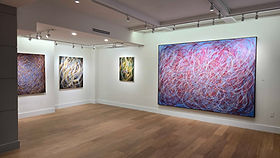
Guffogg’s canvases are filled with countless thin, interwoven lines with no discernible beginning or end. As dozens of these layers accumulate, they create a sense of deep space—an abyss that resembles the orbital paths of planets. These lines represent the history of stars, born hundreds of thousands of light-years ago, whose light is only now reaching our eyes.
Technique: A Devotional Process
The artist’s unique technique involves binding three brushes of different sizes together, moving them in unison to translate the infinite world onto the canvas. This repetitive process of drawing slender, trajectory-like lines is akin to a spiritual practice or a seeker’s meditation.
The Intersection of Past and Present
Inspired by images from the James Webb Space Telescope, Guffogg focuses on the flow of time and space. His philosophy is rooted in the idea that what we perceive as the "past" (the light from distant stars) is actually our "present." His work challenges the viewer to face the traces of yesterday, the shadows of today, and the brilliance of tomorrow all at once.