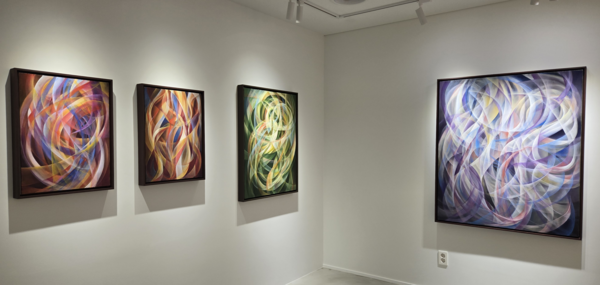
The solo exhibition Memories of Our Future by American artist Shane Guffogg is on view from September 2 to October 10 at Gallery Chang Seoul (B2, No. 8, Oakwood Premier, 46 Teheran-ro 87-gil, Gangnam-gu, Seoul), bringing the artist’s lifelong inquiry into time and consciousness to Korean audiences.
Memories of Our Future poses a deceptively simple question at the heart of its experience: How can memory become the future? From the center of Gangnam, Guffogg invites viewers to contemplate this paradox through a body of work that fuses cosmology, perception, and painterly time.
As part of the fall exhibition season, Gallery Chang Seoul (CEO Jang Jun-hwan) presents this major solo show, which centers on large-scale canvases completed at the artist’s Strausmore Ranch studio in California. The exhibition distills Guffogg’s decades-long philosophical exploration of light, time, and perception.
While Guffogg employs traditional materials, his process resists fixed plans. Working without preliminary sketches, he relies on the subconscious and improvisation, building up dozens of translucent glaze layers over months. As colors and forms accumulate on the canvas, past and future, consciousness and the unconscious, become intricately intertwined—forming a unique painterly “record of time.”
Guffogg explains, “Time is not linear; the past we perceive is, in fact, the present.” This philosophy forms the core of the exhibition and translates into the multilayered experience of time that viewers encounter before his works.
A key source of inspiration for this exhibition comes from images captured by the James Webb Space Telescope, particularly scenes of stellar birth and extinction. Reflecting on these cosmic images, Guffogg notes, “Looking into the universe, I realized that the past is constantly touching the present. We must recognize the past to understand the now, and only then can we prepare for the future.”
The ribbons, veils, and oscillations of color that unfold across his canvases evoke refractions of light and tremors of time, generating the sensation that human memory and cosmic movement are intimately connected.
Beyond visual pleasure, Guffogg’s paintings carry a synesthetic resonance. Color can feel musical; brushstrokes ripple like waves. Viewers experience not a single point in time, but multiple temporalities and sensations simultaneously—an encounter that encourages a sense of presence extending beyond the confines of the “now.”
This exhibition does not merely recall the past or predict the future. Rather, it is an invitation to inhabit the present more deeply. Memory flows into the future, and the future, Guffogg suggests, is already being formed within memory. The gallery space becomes a site of contemplation, where viewing transforms into an experience of rethinking time itself.
Guffogg recently drew international attention during the Venice Biennale period with an installation combining painting and music at Palazzo Contarini del Bovolo. The Seoul exhibition is expected to mark another pivotal moment in his expanding global trajectory, further deepening his central themes of memory and time.
Born in California in 1962, Shane Guffogg currently works at Strausmore Ranch, surrounded by vineyards, olive trees, and the rhythms of seasonal change. Nature’s cycles permeate his work. He explores science, music, and the inner landscapes of human memory, translating the meeting point of cosmic order and personal consciousness into a painterly language.
By merging classical techniques with contemporary thought, Guffogg reveals the temporality of painting itself. His method of layering dozens of transparent glazes allows light to permeate the surface, enabling physical time and psychological time to coexist within a single frame. The resulting works are not merely images, but traces of time and consciousness.
Art critic Victoria Chapman (Los Angeles) describes the exhibition as “an artistic shock that revives senses lost in contemporary society.” She emphasizes that even in an era where technology and convenience mediate human experience, art retains the power to return us to the essence of time and sensation.
“We fear the future,” Chapman notes, “yet we are already living inside it.” She points to autonomous vehicles, robots, and digital systems that dominate daily life, warning that while machines learn faster than humans, our capacity to feel and reflect deeply risks growing dull. Emotional connection and shared language, she argues, are increasingly endangered.
In this context, Chapman sees Guffogg’s work as offering a vital alternative: “His paintings are not technological spectacles. They suspend us in a state of weightlessness, freeing us from clocks and efficiency. By redefining time and reconnecting past and future, they restore human sensibility.”
She concludes emphatically, “Who today still descends into the depths of identity, traversing darkness out of a necessity to create? Shane Guffogg is the answer.”
Chang Jun-hwan, CEO of Gallery Chang, explains that Memories of Our Future marks Guffogg’s first overseas engagement following his Venice Biennale presentation. After his acclaimed exhibition Stranger of Time at Palazzo Contarini del Bovolo—widely covered by international media including the BBC—Guffogg chose Seoul as his next destination.
“This decision signals Seoul’s emergence as a global center for contemporary art,” Chang notes. “The city is rapidly becoming a hub where major galleries converge and leading artists begin their international trajectories.”
The exhibition features new works inspired by James Webb Space Telescope imagery, alongside paintings that condense light and time onto the canvas. Within the paradoxical title Memories of Our Future, viewers are invited to reconsider the meaning of time and existence.
Chang adds, “That Seoul is the first stop after Venice demonstrates how the Korean art scene is shifting from consumption to discourse. We hope this exhibition will become a new bridge between Korean and global art communities.”